


Eye prescriptions can look confusing at first glance. They include many numbers, abbreviations, and terms that may be unfamiliar. But each part of your prescription plays an important role in ensuring your glasses or contact lenses provide the vision correction you need.
Understanding how to read your eye prescription can help you feel more confident about your eye health. It can also help you avoid mistakes when ordering glasses or contact lenses and give you a better understanding of your vision needs. In this guide, we will explain each part of an eye prescription in clear, simple terms so you know what each value means and how it affects your vision.
Understanding the Basics of Vision Correction
Vision correction helps your eyes focus light so images are clear. If this does not happen, it can cause common vision problems such as:
- Nearsightedness (myopia)
- Farsightedness (hyperopia)
- Astigmatism
- Presbyopia (age-related near vision loss)
Glasses and contact lenses correct these vision problems by altering how light enters your eyes. There are several types of lenses available, including single-vision, bifocal, and progressive lenses. Some lenses also have special coatings that protect your eyes from UV light, reduce glare, or help with digital eye strain.
Your eye prescription acts as a blueprint for the optical lab. It tells them exactly how to make lenses tailored to their eyes and specific vision needs.
What Is an Eye Prescription?
An eye prescription is a set of measurements you get after a full eye exam. It tells you:
- How strong your lenses need to be
- Whether you have astigmatism
- Whether you need help with near vision
- Any special corrections required
Eye prescriptions use a standard format that is recognized around the world. This means any optical provider can fill your prescription accurately, no matter where you are.
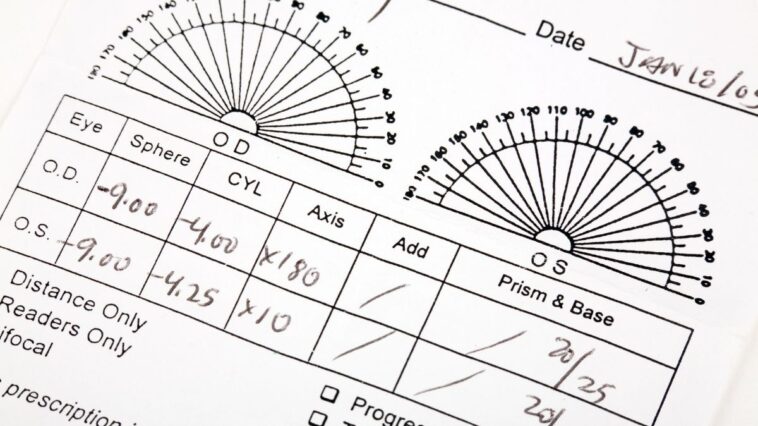
The Difference Between OD and OS
You’ll see two key abbreviations on every eye prescription:
- OD (oculus dexter) – right eye
- OS (oculus sinister) – left eye
These Latin terms help your eye doctor record the measurements for each eye. Since many people have different prescriptions for their right and left eyes, it is important to keep these values separate.
How to Read an Eye Prescription (Step by Step)
Once you understand what each term means, reading your eye prescription becomes much easier.
Step 1: Identify the Right and Left Eye
Look for the OD and OS columns. Each contains measurements specific to that eye.
Step 2: Understand the Spherical Power (SPH)
SPH stands for Sphere. This value tells you how strong your lenses need to be to correct nearsightedness or farsightedness.
- A negative (–) number means nearsightedness.
- A positive (+) number means farsightedness.
A higher number means a stronger lens correction is needed.
Step 3: Check the Cylinder (CYL)
CYL stands for Cylinder. This value indicates whether you have astigmatism and how much correction your lenses need to provide.
Astigmatism occurs when the cornea is not perfectly round, leading to blurred or distorted vision. If your prescription does not include a CYL value, it means you do not need astigmatism correction.
Step 4: Read the Axis
AXIS is used together with the cylinder value. It shows the direction where the astigmatism correction is needed. The axis is measured in degrees, from 0 to 180.
Axis values do not show how strong the correction is. They only indicate the direction for the astigmatism correction.
Step 5: Look for the ADD Power (If Present)
ADD is a value that appears on prescriptions for people who have presbyopia. Presbyopia is a common condition that usually develops after age 40 and affects near vision.
This value shows the additional lens power needed for close-up tasks such as reading. ADD values are always positive and are used for bifocal or progressive lenses.
Step 6: Understand Pupillary Distance (PD)
Pupillary distance, or PD, is the measurement in millimeters between the centers of your pupils. This measurement helps ensure your lenses are correctly positioned in front of your eyes for optimal vision.
Some prescriptions list one PD number for both eyes, while others provide a separate PD measurement for each eye.
Step 7: Prism Correction (If Needed)
If your eyes do not line up properly, your prescription may include a prism correction. Prism correction can help reduce double vision or eye strain that happens when the eyes are not aligned correctly.d.
If your eyes do not line up properly, your prescription may include a prism correction. Prism correction can help reduce double vision or eye strain that happens when the eyes are not aligned correctly.d.
Prism values show both the strength and the direction of the correction needed.
Step 8: Lens Type
Your prescription may specify:
- Single-vision lenses (one correction)
- Bifocals (two distinct viewing areas)
- Progressive lenses, which provide a gradual change in lens power so you can see clearly at all distances, from far away to up close
The type of lens your prescription recommends depends on your vision needs and your daily activities.
Conclusion
Knowing how to read an eye prescription helps you understand your vision and get the right lenses. Each value, whether for nearsightedness, astigmatism, or near vision, is important for clear, comfortable vision.
It is important to have regular eye exams because your prescription can change over time. Keeping your prescription up to date helps protect your vision and supports the long-term health of your eyes.