Contents
hide
Intraocular lens (IOL) implants are a proven way to restore clear vision after cataract surgery. If you are getting ready for cataract surgery, or if you are helping a loved one learn about their options, it is helpful to understand what an intraocular lens implant is, how the procedure works, the types of lenses you can choose from, and what to expect regarding risks, costs, and long-term results.
This guide will walk you through these topics in clear, easy-to-understand language.
What Is an Intraocular Lens Implant?

An intraocular lens implant (IOL) is a small, artificial lens placed inside the eye to replace the natural lens that has become cloudy from cataracts.
Most intraocular lenses are made from strong, long-lasting materials like acrylic or silicone. Once placed, they are meant to stay in your eye for the rest of your life.
Most intraocular lenses are made from strong, long-lasting materials like acrylic or silicone. Once placed, they are meant to stay in your eye for the rest of your life.
After the IOL is implanted, it helps focus light onto the retina, which is the light-sensitive layer at the back of your eye.
This can restore clear vision and may reduce your need for glasses or contact lenses.
This can restore clear vision and may reduce your need for glasses or contact lenses.
The type of IOL you and your doctor choose can help correct different vision problems, including:
- Nearsightedness
- Farsightedness
- Astigmatism
- Presbyopia (age-related near-vision loss)
Cataract surgery with IOL implantation is the most common surgical procedure performed worldwide. It has a very high success rate, with over 95% of people experiencing better vision after surgery.
Types of Intraocular Lens Implants
Choosing the right IOL is an important step in planning for cataract surgery. Each lens type has its own benefits, depending on your lifestyle, vision needs, and whether you have refractive errors like nearsightedness or astigmatism.
1. Monofocal IOLs (Standard Lenses)
- Monofocal lenses provide clear vision at one distance, usually set for distant vision.
- These are the most commonly used lenses in cataract surgery.
- If you choose a monofocal lens, you will likely still need to wear reading glasses for close-up tasks like reading or sewing.
Best for: Patients who prioritize sharp distance vision
2. Multifocal IOLs (Distance + Near Vision)
Multifocal lenses have several focusing zones built into the lens. This design helps you see clearly at different distances, such as:
- Up close
- At intermediate range
- At distance
Benefits: Greater independence from glasses
Some people with multifocal lenses may notice glare or halos around lights, especially at night.
Some people with multifocal lenses may notice glare or halos around lights, especially at night.
3. Toric IOLs (For Astigmatism)
Toric lenses are designed to correct corneal astigmatism, providing much clearer distance vision.
These lenses are best for people with moderate to high astigmatism.
Benefit: Reduced dependence on prescription glasses
Benefit: Reduced dependence on prescription glasses
4. Accommodating IOLs
Accommodating IOLs are made to move slightly inside your eye as you focus on objects at different distances. This movement helps copy some of the natural focusing ability of your original lens.
Advantage: Clearer intermediate vision (e.g., dashboard, computer screen)
They may not be as effective for close-up reading as multifocal lenses
They may not be as effective for close-up reading as multifocal lenses
.
5. Phakic IOLs (Lens Added Without Removing Natural Lens)
Phakic IOLs are sometimes used for people with very high levels of nearsightedness (myopia), especially if laser vision correction procedures like LASIK or PRK are not a good option.
Unlike other IOLs, phakic lenses are placed in the eye without removing your natural lens. They are not used during cataract surgery.
How an Intraocular Lens Implant Procedure Works
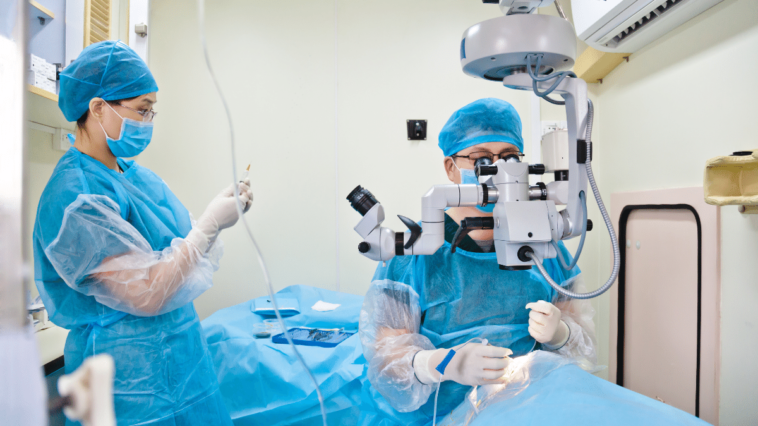
Cataract surgery with IOL implantation is usually done with local anesthesia to numb your eye. The procedure usually takes about 10 to 20 minutes for each eye.
Step-by-step overview
- Numbing the eye: Drops or injections ensure you feel no pain.
- Tiny corneal incision: A very small incision is made at the edge of the cornea, which is the clear front part of your eye.
- Lens removal: The cloudy natural lens is then carefully broken up using ultrasound or a laser and removed from the eye.
- IOL insertion: The new artificial lens is folded and inserted through the small incision, then gently unfolded and positioned.
- No stitches needed: Incisions usually self-seal.
Recovery:
After surgery, most people notice that their vision becomes clearer within 24 to 48 hours.
After surgery, most people notice that their vision becomes clearer within 24 to 48 hours.
Risks & Possible Complications
IOL implant surgery is very safe, but as with any procedure, there are some risks. Most complications are rare and can be treated if they occur.
Potential Risks
- Infection (endophthalmitis)
- Inflammation
- Bleeding
- Corneal swelling
- Elevated eye pressure
- Retinal detachment (rare)
- Incorrect IOL power (rare)
- Glare or halos (more common with multifocal lenses)
Posterior Capsule Opacification (PCO)
This is sometimes called a secondary cataract. It happens when a thin membrane behind the implant becomes cloudy. This can occur months or even years after your surgery.
Treatment:
A quick laser procedure (YAG capsulotomy) restores clarity in minutes.
A quick laser procedure (YAG capsulotomy) restores clarity in minutes.
Postoperative Care After IOL Implant Surgery
Proper aftercare is important for achieving the best possible results from your surgery.
What patients should do:
- Use prescribed antibiotic and anti-inflammatory drops.
- Wear sunglasses when you are outside to protect your eyes from bright light.
- Sleep with a protective eye shield for the first one or two nights after surgery.
- Avoid rubbing the eye.
- Avoid heavy lifting or exercise for 1 week.
- Keep water out of your eyes for 3 to 5 days after surgery.
Your doctor will also schedule follow-up visits to check your healing. These usually occur:
- 24 hours after surgery
- 1 week
- 1 month
- Additional visits if needed
Most people can return to their normal daily activities within two to three days after surgery.
How Much Do Intraocular Lens Implants Cost?
In most cases, insurance will cover the cost of a standard monofocal IOL if you are having cataract surgery.
Typical ranges (varies by country):
| Standard Monofocal IOL | Usually covered by insurance |
| Toric IOL | +$500–$1,000 additional |
| Multifocal IOL | +$1,000–$3,000 additional |
| Accommodating IOL | +$1,000–$2,500 additional |
| Phakic IOL | $3,000–$5,000 per eye |
Insurance usually covers monofocal IOLs for cataracts.
If you choose a premium lens, such as a multifocal or toric IOL, you may need to pay some or all of the cost yourself.
If you choose a premium lens, such as a multifocal or toric IOL, you may need to pay some or all of the cost yourself.
Pros and Cons of Intraocular Lens Implants
- Pros
Most people notice a dramatic improvement in their vision after IOL implantation.
The vision correction provided by an IOL is long-lasting and permanent.
Recovery from IOL surgery is usually quick and not painful for most people.
✔ Can reduce or eliminate the need for glasses
✔ Highly successful procedure worldwide
The vision correction provided by an IOL is long-lasting and permanent.
Recovery from IOL surgery is usually quick and not painful for most people.
✔ Can reduce or eliminate the need for glasses
✔ Highly successful procedure worldwide
- Cons
Premium IOLs, such as multifocal or toric lenses, can be more expensive and may not be fully covered by insurance.
Some people with multifocal lenses may notice glare or halos, especially at night or while driving.
Some people with multifocal lenses may notice glare or halos, especially at night or while driving.
You may still need glasses for certain tasks
There is a small risk of complications
There is a small risk of complications
FAQs
How long does an intraocular lens implant last?
In most cases, an intraocular lens implant is designed to last a lifetime. The material used in modern IOLs does not break down or wear out. Once the cloudy natural lens is removed and replaced, the implant stays in place permanently unless a rare complication requires repositioning or exchange.
Can you feel an intraocular lens inside your eye?
No. An IOL cannot be felt once it’s implanted. It becomes part of the eye’s internal structure, and patients do not feel pressure, movement, or discomfort from the lens itself. Any sensation after surgery is typically part of the normal healing process.
Do I need glasses after getting an intraocular lens implant?
Whether you need glasses after surgery depends on the type of IOL you and your eye doctor choose.
Monofocal lenses usually mean you will need reading glasses for close-up work. Multifocal and accommodating IOLs can reduce the need for glasses at different distances, but even with these premium lenses, some people still use glasses for reading fine print or for extended reading.
Monofocal lenses usually mean you will need reading glasses for close-up work. Multifocal and accommodating IOLs can reduce the need for glasses at different distances, but even with these premium lenses, some people still use glasses for reading fine print or for extended reading.
Can an intraocular lens implant shift out of place?
A lens implant rarely moves out of place, but it can if the lens capsule becomes weak or if the eye is injured. Symptoms may include blurry vision, double vision, or glare. If this happens, your eye doctor can reposition or replace the lens if needed.
Are there activities I should avoid after receiving an IOL implant?
For the first week after surgery, avoid heavy lifting, bending forward too much, swimming, rubbing your eyes, and exposure to dust and wind.
Most people can return to their normal daily activities within a few days, but you should wait to do strenuous exercise until your surgeon says it is safe.